
Siberian Husky vs Golden Retriever: Which Family Dog Wins?

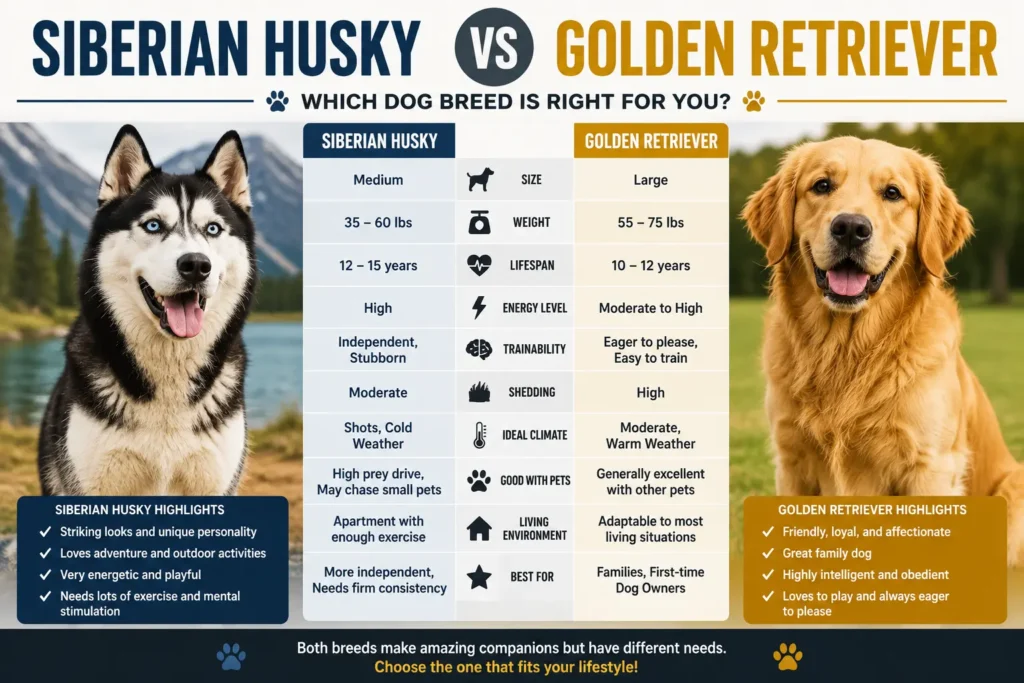
The first time I stood between a friend’s Siberian Husky and my neighbor’s Golden Retriever at the local dog park, I understood exactly why the Siberian Husky vs Golden Retriever debate never really settles. One dog was howling at a passing siren like it owed him money. The other was already belly-up, asking every stranger within ten feet for a scratch. Same species, completely different universe.
If you’re weighing a Siberian Husky vs Golden Retriever as your next family dog, you’re not just picking a coat color or a size. You’re picking a lifestyle. This guide breaks down the real, current differences temperament, cost, shedding, training, health, and 2026 popularity data so you can decide with your eyes open, not just your heart.
Siberian Husky vs Golden Retriever: Breed Origins
Understanding where each breed came from explains a lot about how they behave today.
The Siberian Husky was bred by the Chukchi people of northeastern Asia to pull sleds across brutal, frozen terrain for long distances on minimal food. Endurance, independence, and pack-based decision-making were survival traits not optional extras.
The Golden Retriever, by contrast, was developed in 19th-century Scotland by Lord Tweedmouth to retrieve waterfowl for hunters. Retrievers were bred to work closely alongside a single handler and to have a “soft mouth” gentle enough to carry a bird without damaging it. That cooperative, people-pleasing instinct is baked into the breed.
So when you frame the Siberian Husky vs Golden Retriever comparison through breed history, the pattern is clear: one dog was built to run with a pack, the other was built to work beside a person.
Siberian Husky vs Golden Retriever: Temperament and Personality
The Independent Husky Mindset
Huskies are famously vocal, mischievous, and stubborn. They’re friendly with people (often too friendly to make a good guard dog) but they’re also escape artists with a strong prey drive. According to the American Kennel Club, Huskies were bred to work in teams, which is why they often get along beautifully with other dogs but can be selectively harder to train one-on-one.
The People-First Golden Retriever
Golden Retrievers are consistently ranked among the most trainable, affectionate, and even-tempered breeds in the country. They tend to bond intensely with their families and generally don’t do well being left alone for long stretches.
In the Siberian Husky vs Golden Retriever temperament comparison, families that want a dog who checks in constantly for guidance usually lean Golden. Families who enjoy a more cat-like, independent companion tend to appreciate the Husky’s streak of self-sufficiency.
Siberian Husky vs Golden Retriever: Size, Coat, and Shedding

Both breeds carry thick double coats and shed heavily, especially during seasonal “blowouts” in spring and fall but the maintenance experience isn’t identical.
| Trait | Siberian Husky | Golden Retriever |
|---|---|---|
| Average height | 20–23.5 in | 21.5–24 in |
| Average weight | 35–60 lbs | 55–75 lbs |
| Coat type | Double coat, medium length | Double coat, wavy/feathered |
| Shedding level | Heavy, seasonal “coat blow” | Heavy, near-constant |
| Grooming frequency | 2–3x weekly (more during blow) | 2–3x weekly |
| Average lifespan | 12–14 years | 10–12 years |
Golden Retrievers tend to shed steadily all year, while Huskies shed less overall but “blow” their undercoat dramatically twice a year. Neither is hypoallergenic, so allergy-prone households should look elsewhere.
Siberian Husky vs Golden Retriever: Exercise and Energy Needs
This is where the Siberian Husky vs Golden Retriever decision gets real for a lot of first-time owners. Huskies were built for distance think 60+ minutes of vigorous activity daily, ideally with a job to do like running, hiking, or pulling. Under-exercised Huskies get destructive fast.
Goldens are also energetic, especially as puppies, but their exercise needs are more moderate and flexible: a solid daily walk plus playtime and swimming (they love water) usually keeps them content.
Personally, I’ve watched a Husky reduce a fenced backyard to rubble in an afternoon out of pure boredom, while the Golden next door was perfectly happy chewing a rope toy on the porch. Energy management isn’t optional with either breed, but the ceiling is noticeably higher with a Husky.
Siberian Husky vs Golden Retriever: Trainability and Intelligence
Both breeds are intelligent, but intelligence doesn’t always translate to obedience. Golden Retrievers were engineered to want to please their handler, which makes them some of the easiest large breeds to train they’re a fixture in service dog and therapy dog programs for exactly that reason.
Huskies are just as smart, but their intelligence is oriented toward solving problems for themselves, not for you. Recall (coming when called) is notoriously unreliable in Huskies because of their strong prey drive and independent streak, so secure fencing is non-negotiable.
If you want a deeper look at how selective breeding shaped these behavioral differences, the science behind canine behavior genetics is worth a read before you commit to either breed.
Siberian Husky vs Golden Retriever: Health and Lifespan
Golden Retrievers, unfortunately, have a well-documented predisposition toward certain cancers and joint issues like hip dysplasia, which contributes to their shorter average lifespan of 10–12 years. Huskies are a generally hardier breed with fewer major hereditary conditions, though eye issues like cataracts and progressive retinal atrophy do occur, and they tend to live 12–14 years.
Reputable breeders for both breeds should provide health clearances from organizations like the Orthopedic Foundation for Animals (OFA). If you’re researching a Golden specifically, our Golden Retriever Guides hub covers breed-specific health screening in more depth.
Siberian Husky vs Golden Retriever: Cost of Ownership
Sticker price is only the starting point. Here’s how the numbers typically stack up in the United States for 2026:
| Cost category | Siberian Husky | Golden Retriever |
|---|---|---|
| Puppy price (reputable breeder) | $800–$2,000 | $1,000–$3,500 |
| Annual food cost | $500–$700 | $600–$900 |
| Annual vet care | $500–$800 | $700–$1,200 |
| Grooming (if professional) | $50–$80/visit | $60–$90/visit |
| Pet insurance (monthly) | $35–$55 | $45–$65 |
Golden Retrievers generally cost more over a lifetime due to higher food volume (they’re a larger breed on average) and a higher likelihood of costly health issues like cancer treatment or joint surgery.
According to Statista’s most recent pet ownership survey, U.S. households now spend more on pet care than ever before, with veterinary costs and premium food driving much of that growth. Larger, higher-energy breeds like both the Husky and the Golden tend to sit above the national average annual spend, which is worth factoring in before adoption day.
Siberian Husky vs Golden Retriever: Popularity Trends in 2026
Popularity data adds useful context to the Siberian Husky vs Golden Retriever conversation. According to the American Kennel Club’s most recent U.S. registration statistics, the Golden Retriever holds steady at #3 among all recognized breeds, while the Siberian Husky sits around #30, having slipped a few spots from the previous year. That gap reflects a broader trend: family-oriented, easy-to-train breeds continue to dominate U.S. households, while high-energy working breeds appeal to a smaller, more specialized owner base.
Search interest tells a similar story Golden Retrievers consistently rank among the most-searched breeds for families, while Husky searches spike around cold-weather months and viral social media clips of their vocal antics.
Which Wins for Families? Final Verdict
There’s no universal winner in the Siberian Husky vs Golden Retriever matchup there’s only the better fit for your household. Choose a Golden Retriever if you want a devoted, trainable companion who thrives on togetherness and moderate exercise. Choose a Siberian Husky if you’re an active owner with secure fencing, patience for a stubborn streak, and a genuine love of cold-weather adventure.
Whichever way you lean in the Siberian Husky vs Golden Retriever decision, both breeds reward owners who show up consistently with structure, exercise, and affection.
Frequently Asked Questions
Is a Siberian Husky or Golden Retriever Better with Kids?
Golden Retrievers are generally the better choice for families with young children. They are known for their gentle, patient, and affectionate temperament. Siberian Huskies can also be excellent family dogs but are usually better suited to homes with older children who understand how to interact respectfully with energetic dogs.
Which Sheds More, a Husky or a Golden Retriever?
Both breeds are heavy shedders, but they shed differently. Golden Retrievers shed consistently throughout the year, while Siberian Huskies typically experience two major seasonal shedding periods, known as “blowing their coat,” during which they lose large amounts of fur over a short time.
Are Huskies or Golden Retrievers Easier to Train?
Golden Retrievers are generally easier to train because they are eager to please, highly intelligent, and respond well to positive reinforcement. Siberian Huskies are intelligent as well, but their independent nature often requires more patience, consistency, and motivation during training.
Do Huskies or Golden Retrievers Need More Exercise?
Siberian Huskies usually require more daily exercise than Golden Retrievers. Most Huskies thrive with 60 to 90 minutes of vigorous physical activity each day, while Golden Retrievers are typically satisfied with 45 to 60 minutes of walks, playtime, swimming, or other moderate exercise.
So, in the Siberian Husky vs Golden Retriever debate, which breed matches the life you actually live day to day?